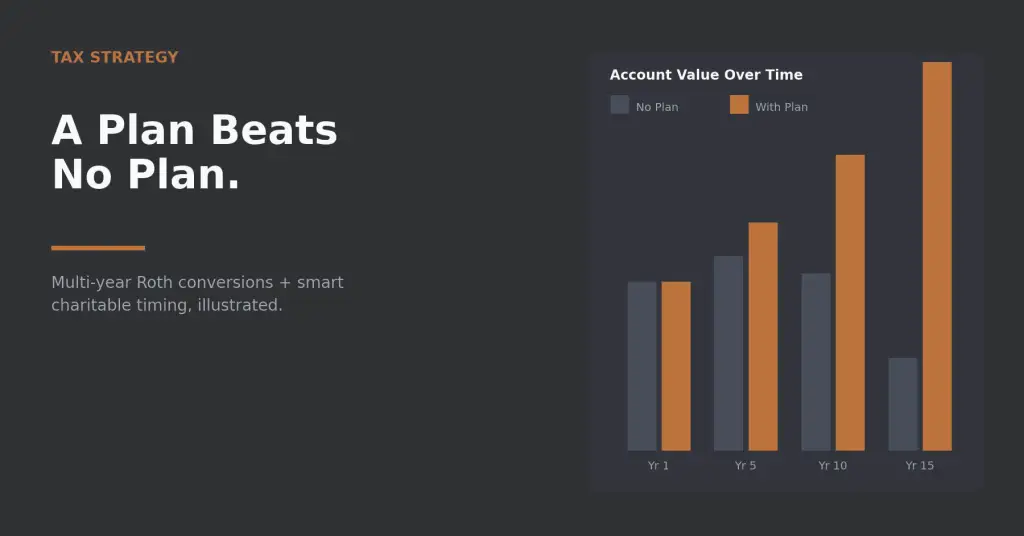
Here’s a hypothetical, illustrative example — the kind of scenario we see often — showing why “just take the RMDs when they’re required” is rarely the cheapest path.
The Setup
Picture a couple approaching retirement with a healthy nest egg in a traditional retirement account — say $1.5 million — sitting alongside a smaller taxable investment account. They’re comfortably in the 22-24% federal tax bracket, own their home outright, and give to charity most years. Nothing unusual. This describes a huge number of households.
Left alone, that account will keep growing tax-deferred until Required Minimum Distributions force withdrawals in their mid-70s — at exactly the point balances (and RMDs) are largest. Big forced withdrawals on top of Social Security and other income can push a comfortable retirement into a higher bracket, trigger Medicare premium surcharges (IRMAA), and hand a fully taxable account to heirs.
The Alternative: Convert on Purpose, Not by Accident
Instead of waiting, we build a plan that converts a slice of the traditional account to a Roth IRA every year during the lower-income years right after retirement — filling up the current tax bracket, but not spilling into the next one. Over roughly a decade, a meaningful share of that account moves from “taxable forever” to “tax-free forever.”
Charitable giving gets the same treatment. Instead of writing a check every year — which often doesn’t even clear the standard deduction — gifts get bunched into larger, less-frequent contributions timed to years when itemizing actually pays off. Once the household reaches Qualified Charitable Distribution age, giving directly from the retirement account becomes the more efficient move, since it lowers taxable income no matter the standard deduction.
What It’s Worth
In a representative version of this plan, the difference between “do nothing and let RMDs happen” and “convert deliberately, give strategically” runs well into six figures over the household’s lifetime — often $150,000 to $250,000+ depending on account size, bracket, and time horizon — with a meaningfully larger tax-free balance left over at the end. Every dollar moved into a Roth account before it has to come out is a dollar that never gets taxed again, and neither do its future decades of growth.
Why This Isn’t a One-Size-Fits-All Move
The right amount to convert, and when, depends on current income, future income, account type (a 401(k) has different rollover rules than an IRA), state taxes, Medicare thresholds, and charitable intent — all of which change every year as tax law changes. A plan built once and never revisited usually underperforms one that gets checked annually against real numbers.
If a meaningful chunk of your net worth is sitting in a traditional 401(k) or IRA, it’s worth running the numbers on a conversion strategy before RMDs make the decision for you.
This is an illustrative example for educational purposes, not a specific client case. Every household’s numbers are different — talk to your CPA before making conversion or charitable-giving decisions.